Thursday, May 29, 2014

Blog Post #1

My name is Savanah Moore! I am 19 years old. I live in Axis, Alabama in the northern part of Mobile County. I have lived there my whole life. I have a sister who is 12 and a brother who is 31. I also have a sister-in-law and 3 nieces and 2 nephews. I enjoy hunting, fishing, and getting pedicures with my best friend!
I go to Shiloh Baptist Church in Saraland, Alabama. I'm am greatly involved with our special needs children on Sunday. I also help with teaching children's choir. I am Youth Services Assistant Director at the North Mobile YMCA in Saraland in the Youth Services department. I work after-school care during the school year and summer camp during the summer.
IMG_0548.JPG     IMG_6045.JPG
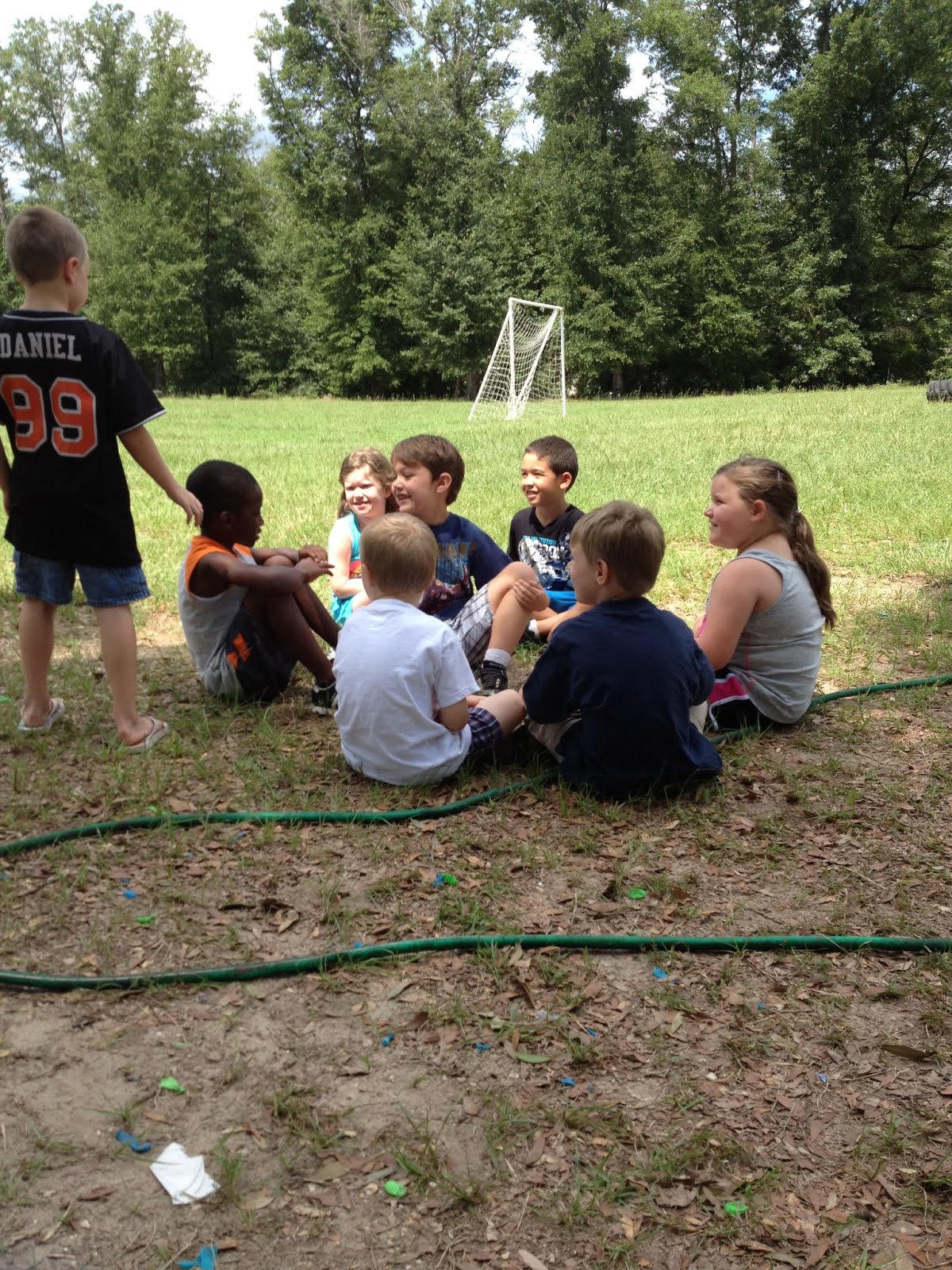
My kids are my passion and one of the reasons I am going into education! This is only a few of the kids I keep on a daily basis. And yes, I call them MY kids because they are! Over the last 2 ½ years, I have spent every school day, summer day, and most holidays with them; teaching them, getting to know them, and caring for them! I think in today's world we lack teachers who really care about their students! Not all but some people just teach because they couldn't think of anything else they wanted to do. I don't want to be that kind of teacher! I want to KNOW my kids; their favorite color, about their family, and what really upsets them! I want them to know that they have someone who cares about even the silliest little things! They need to know that I am rooting for them to succeed!

Sunday, December 8, 2013

Blog Post #16 Final Reflection

Part 1:

Honestly, I wouldn't change my blog post #1 very much after going through this class. I do still plan on using pencils, crayons, and paper a lot. I do plan on using technology more than I originally thought. I am going to be a elementary special education teacher and I thought there is no way those kids are going to be able to comprehend the technology the way a normal elementary class would. I went and visited a special education class and changed my mind. The teacher started the class every morning with the SMARTboard. The screen had the day of the week, a calender and different choices of weather. Each student got to get up and pick what day it was, what the date was, and what the weather was like outside. Next they would have to match the different colored socks or put outfits together. She used the SMARTboard to teach them everyday things that would help them in life. I thought that it was a really awesome idea to teach them something that they will use for the rest of their lives. I have learned a lot more to do with the SMARTboards than what I did with them in school and I will definitely use them a lot more than I thought I would.

Part 2:

Sunday, December 1, 2013

Blog Post 15

With today’s technologies helping special needs students achieve so much more than in the past. The assistive technologies allow students with disabilities to participate in the learning activities and curriculum. In the video Assistive Technologies for Vision and Hearing impaired Children we see students learning using assistive technologies. The students read a book that uses words like “Zoom” to describe the sound a boat makes. This allows hearing impaired students to imagine what a boat really sounds like. We also see a blind student reading a book written in Braille. These are only two of the more simple assistive technologies available. These simple tools allow students to interact with their classmates and learning environment. With the ever advancing technology world we as teachers should always stay knowledgeable on the tools available to us. Also to ensure that the student is receiving the best possible learning experience a thorough assessment of the student’s abilities should be done to know where they are struggling.
        The video about the MountBatton, we learn about a system that is used to help enhance learning for the visually impaired. This system allows students to write Braille and hear what they are writing as they are typing it. This allows students to learn Braille while also staying involved in the classroom discussions and group work. Another way to enhance a student that has learning disabilities to participate in class is to teach the other students how to work with the student. For example, a visually impaired student may be more willing to participate in peer reviews if they know their paper will be read by a peer and not the teacher. So teaching the other students how to read basic Braille may help strengthen the learning environment. When planning lesson plans involving these assistive tools it is important to combine multiple tools to allow the student a single tool will not meet all the needs of your student. While researching assistive tools we found the website EnablingDevices which is a website that sells devices for all disabilities. This site is a very good site to have. It shows you what tools are out there and what tools you could need for your students with disabilities. The most important aspect of helping a student with disabilities achieve their goal is to work together, with the students parents and other administrators to guarantee that your student is achieving their goals.

blog post 15 c and d

Learning mathematics can be tough for anyone, but for blind students, it can be a challenging task, in learning math.  In the video, Teaching Math to the Blind Professor Art Karshmer, who is a professor at University of San Francisco School of Management, introduces a  tool he has created  for blind students. This tool  uses blocks and a grid. His device  lays out simple math problems to more advanced math problems using small blocks. On the front, there is  braille  and visible numbers. In the video, he demonstrates that the blind student will use a barcode scanner, on the blocks. The device reads the number back to the student. The student places the block on the grid to set up the math problem. The math problem is laid out on the touch bed. Professor Art Karshmer shows how the problem is laid out the way a sighted person would put it on paper. A blind person can rub their finger across the problem and read it. Now, a  blind student is able to work on a two-dimensional problem. By using this program, it will help educate young blind students. It can cover areas like: basic Math and the beginning Algebra.


After watching Professor Art Karshmer video, we did further research on  math tools for blind students. We found information on a blind woman named Sheila Schneider. She majored in sculpture at the School of Art Design. Under the supervision of  Deana McDonagh, a professor of Industrial Design. Sheila Schneider has created six small hand held sculptures that have mathematical equations written in Braille. The math equations will be written in Nemeth Code, a form of Braille used with math and scientific symbols. This tool will be used to help students with visual impairments that will help them to learn math.

It is great that there are assistive technology available for the blind. In the video, iPad usage for the blind  Wesley Majerus who is an Access Specialist for the National Federation for the Blind. In the video,  Mr. Majerus  demonstrations how blind people can use different apps with an iPad. The iPad has a voiceover that tells him, which programs he is opening. The voiceover helps him to navigate around the home screen. There is an app that can read a book aloud. He expresses that it is very liberating to buy and read books. This tool, is a great assistive technology device that can help blind people.


Having a great time teaching mom what her deaf/blind child is learning on the iPad is great video of a teacher teaching a mom how to use the voice features on the iPad. They run their fingers across the screen and it reads what app their finger is on. To choose the app they double tap anywhere on the screen. It also has a few different kinds of keyboards including one where you run your finger across the keyboard and then hold down the letter you want to use.

Tuesday, November 26, 2013

SMARTboard Project #12b

<iframe width="560" height="315" src="//www.youtube.com/embed/0E7K4h3C3YA?rel=0" frameborder="0" allowfullscreen></iframe>

Monday, November 11, 2013

Blog Post #12

In the video, How to escape education’s death valley Ken Robinson talks about . He makes a comment that who ever thought of the title “No child left behind” understood irony because the program left millions of children behind. The United States spends more on education that other countries but yet still has a 60% dropout rate. He believes that America is going in the wrong direction. He talks about 3 principles for education. The first is that humans are naturally different and diverse. He talks about how no two kids are alike. He goes on to say that 10% of children in America are diagnosed with some time of ADD. He says that most children are not suffering from a physiological condition, they are suffering from childhood. Children learn best when the curriculum is broad and can celebrate their different talents that just one. The second priciple is curiosity. When a child’s curiosity is sparked, they will go and learn themselves with no push. He goes on and says that children are natural learners. Curiosity is the engine in education. He says that the main point of education is learning. He talks about how you can be doing something but not be engaged in it. He applies that theory to teachers. Someone can be participating in the act teaching but no real teaching going on. The third principle is the human life is creative. We create our own lives. One of the points of education is to awake the power of creativity. He talks about how Finland has high test scores and such. He says that the reason they do is because they individualize teaching and learning. By doing this, they don’t have a dropout rate. They realize that you have to spark student interest and support the teachers. He says that education is not in the government, it’s in the classroom. Teachers know what needs to be done. Education is a human system not a mechanical one. The schools should not be command and control, but should be climate control. If you change the climate or atmosphere, possibilities are endless.
Savanah Moore

In the video Changing Education Paradigms, Ken Robinson talks about the changes being made around the world in public education. He explains how there are two reasons for these changes. The first being economics and the second being cultural. He asks how we educate our children to take our place in the economy. He also asks how we educate our children so that they have a source of cultural identity.  He starts his explanation by saying we are trying to meet the future by doing what they did in the past. I really agree with this quote, and think it is a very strong and representational quote of today’s society. This type of thinking is alienating many kids who do not understand why they need to be in school, because the education system was created for a different generation.

Robinson believes there are two types of education abilities which are economic and intellectual. The academic are considered the smart people who go on to get higher education degrees and the intellectual are the non-smart people, who struggled in school or could not afford to go on to get higher education and who are judged for it. Robinson states how he thinks this has caused chaos. Robinson goes on to say that the non-smart people have had to suffer the ADHD “epidemic.” He believes that we are penalizing our students with drugs because they are distracted by all the technologies of today. He states how we are getting our children through education by anaesthetizing them, or deadening their senses. I really liked what Robinson says when he states that we “should not be putting our students to sleep, we should be waking them up.” This is a great statement, because many students are bored and uninterested in school today.

Robinson explains how school’s today are similar to a factory line, and if we want our students to succeed we need to change from the factory line mentality. Robinson ends his lecture talking about divergent learning and shows a study that was done on a group of students starting in kindergarten through 9th or 10th grade. This study showed how the students’ ability for divergent thinking or creativity deteriorates as the students grow and go through school. He explains how the students’ have gone through years of school being told there is only one answer and that collaboration is bad. Robinson ends saying that in order to change the way our students learn we must think differently about human capacity and not split education into sections. I really liked the final quote he uses “Great learning happens in groups.” This quote goes right along with project based learning, and collaboration in groups.
Jacquelyne Mckiernan

I really enjoyed watching Sir Ken Robinson’s video titled, The Importance of Creativity.  Sir Ken Robinson talk is about why creativity is important. He is very funny and engaging. He started his speech by saying that students starting kindergarten this year will retire in 2065. Robinson explains that, we do not know what the world would look like the in next five years, but we are to educate and prepare students for the future. He shares that creativity should be treated the same as literacy. He had a great quote, “If you are not prepared to be wrong you will never come up with anything original.”  He speaks about today in education; we are stigmatizing mistakes. In the education system,  a mistake is the worst thing you can do. Robinson explains, that the education system has the same hierarchy of subjects, Mathematics and Languages, Humanities and then the Arts.  Under the Arts, there is another hierarchy Art and Music are given a higher status than Drama and Dance. In schools, there is not a class that teaches dance everyday to students, like Math is taught to students. During his talk, Mr. Robinson included a quote from Picasso, “ All children are born artists, the problem is to remain an artist as we grow up.” Robinson says that educator’s task is to educate the whole being so, that they can face the future I really liked Sir Ken Robinson’s story of Gillian,  who became a dancer because ADHD had not been invented  yet. The school wrote her parents because they thought she had a learning disability. Gillian went to see a specialist. The specialist turned the radio on, and the girl began to dance. She was a dancer. The specialist recommendation was to take her to a dance school.  It turned out that he was right. She found other people just like her; people who could not sit still. She became a ballet dancer and a professional choreographer. Today, in schools too many children are mislabeled. I really enjoyed watching Sir Ken Robinson’s video. I learned that the arts should be held in the same hierarchy of content areas. It is important to create an education system that nurtures creativity not destroy it.
Shernaye James
Sunday, November 3, 2013

C4K for October

Nick
Nick talked about how in the book he was reading, the dog, Butterscotch, was a great dog. He also goes on to say that Penny (a character in the book) will be getting more attention.

Aljes
Aljes's post is all about his field trip to Yamnuska. He talks about many diffrent kinds of plants in his post. He shares about moss, lichen, and fungus. Aljes gives facts and a picture of the plant for each.

Monty
Monty talks all sbout the Proboscis monkey. He shares diffrent things about the monkeies like the fact that it has a big nose to help attract a mate. He also includes a picture to help the reader know what he is talking about.

Norah
Norah's post is abut what the story "Out of my Mind" is teaching her. The story is full of life lessons on not giving up and following your deams.